
In partnership with

You are receiving the Community Edition of today’s newsletter - upgrade to a Member to receive additional perks and experiences
A founder who recently visited NYC and San Francisco asked me why you don’t see any Canadian enterprise startups advertising in our cities. Nothing on our subways, stadiums or billboards. After taking an Uber to a hotel in SF on Monday and seeing 100+ AI-related billboards, I thought I should look into it.
Out-of-home (OOH) advertising builds awareness
Out-of-home billboards, transit, bus shelters, airport, building wraps - predates the internet but still works for B2B startups because it reaches the ~95% of your ICP who aren’t in the market today.
Paid search catches people already looking. OOH is a bet on memory. Reed McGinley-Stempel, who runs Stytch and has shipped multiple San Francisco campaigns, frames it as making your audience feel something now so they remember you later.
Frequency × resonance = recall. Kira Klaas, formerly Notion’s VP of brand, splits it into how often it’s seen and how relevant it feels. One board almost never does it. Two to seven impressions a day, across mixed formats, does.
Status signalling. A physical placement says funded, real, still here next quarter. That lands on buyers, recruits, and investors at once. Three audiences, one media buy.
Social amplification. The board is the hook; the internet is the distribution. Bland’s billboard demo video pulled 25 million views, tens of thousands of inbound calls, and hundreds of qualified leads. Vanta’s SOC 2 billboard went up on Reddit organically and helped them land their largest enterprise customer.
SF, NYC and Toronto, in dollars
The following is our best estimate of 2025 OOH spend by market. No public dataset labels advertisers as “B2B startup,” so we triangulated; uncertainty is roughly ±50%.
Market | Total tracked OOH (2025) | Est. B2B-startup portion | Midpoint |
|---|---|---|---|
New York DMA | US$858M | US$20–55M | ~US$35M |
San Francisco DMA | US$224M | US$35–75M | ~US$50M |
Toronto / GTA | ~CAD$220–305M | CAD$2–10M | ~CAD$5M |
The headline: San Francisco probably out-spends New York on B2B-startup OOH in absolute dollars, despite New York's total market being nearly four times larger. Toronto lands at roughly one-tenth of SF after conversion.
The SF allocation (15–25% of the market) is high because the evidence is unusually good: 489 counted faces with nearly half AI-native, 170 billboards on Highway 101 alone, and a digital placement near SFO listed at US$7,000 per week for an eight-second rotating spot. New York gets 2–5% , software was America's sixth-largest OOH category in 2025, but NYC's consumer, tourism, banking, and entertainment spend dilutes it hard. Toronto gets 1–3% of a market built from ~CAD$868M in national 2025 revenue, with 25–35% allocated to the GTA.
Why Toronto looks empty
Capital concentration. The Bay region took ~US$99.4B in venture investment in 2024. Greater New York, US$28.5B. All of Canada: CAD$7B in 2024. More funded companies competing for the same buyers, recruits, and press produces more billboards.
Buyer density. SF tech buyers and VCs move through a handful of neighbourhoods and the 101 corridor. In New York, transit density makes repeat exposure trivial: 1.195 billion subway rides in 2024, ~3.74 million average weekday riders (MTA, 2024). Toronto’s TTC is not small (~2.7 million weekday boardings, TTC 2024), but the relevant buyers and headquarters are spread across the GTA rather than stacked along one route.
Most Canadian B2B startups sell into the United States. A King and Bay placement reaches your engineers, your competitors, and your in-laws. It does not reach a VP of Engineering in Austin.
Regulation is real but not the cause. Toronto prohibits new roof signs, regulates inventory by sign district, and taxes third-party signage. But San Francisco has banned new general-advertising signs since 2002 and still has the densest startup-billboard market on the continent.
Three campaigns worth studying
San Francisco
Stytch, April 2024. One month. 80 bus ads, 130 bus and transit-shelter ads, eight city-street billboards, three billboards on Highway 101. Results, published by the founder: 25%+ uplift in branded search traffic; 70%+ increase in branded search clicks globally; 10–15% uplift sustained after the boards came down; 10%+ of sales opportunities since have cited the billboards or bus ads.
Cost anchor: Unify disclosed spending US$100,000 on its first San Francisco campaign and called that roughly the floor for meaningful presence. Fifteen years ago, a single 101 board ran about US$30K. The market has only tightened.
New York
Brex, and the transit shift. Brex’s Fyre Festival campaign ran a dozen-plus billboards and 1,000 subway cars behind the line “the corporate card that actually lives up to the hype.” Henrique Dubugras has credited billboard spend, as reported, with making the rest of Brex’s marketing work better.
What’s changed since: tech companies now account for about 10% of OUTFRONT’s ads sold in New York City, growing more than 30% year over year from 2024 to 2025. Ramp, Brex, Notion, and Clay are the regulars.
Scale and cost: a half-car subway brand train (570+ cars) has historically run around US$250K/month; a full station takeover clears US$500K. For context, Stripe had US$8.44M in tracked 2025 OOH and OpenAI US$7.79M.
Toronto: the case study that doesn’t exist.
There is no published Canadian B2B-startup OOH case study with both spend and results attached.
What Canadian startups spend visible brand dollars on is instructive: Wealthsimple (consumer, and Canada’s most recognizable tech brand work by a distance); Shakepay (the “Shakemobile,” a wrapped van touring small-town BC and Alberta, 350M+ social views); and Neo Financial (first major brand investment in years, launched March 2026, concentrated on YouTube, bought in-house).
The pattern: when Canadian startups want reach they buy video. When they want physical they buy something mobile and content-native. Almost nobody buys static B2B inventory.
Toronto price context: TTC subway platform posters CAD$1,200–3,500 / 4 weeks; transit shelter faces CAD$700–2,500; interior units CAD$400–1,200; static billboards CAD$2,500–25,000 / 4 weeks; a mid-market Toronto flight CAD$25–75K.
The TTC pulls roughly CAD$32M a year in ad revenue through Pattison. Toronto is not expensive. It’s just not where your buyer is.
Takeaways
OOH is an ROI decision - do the math. Use incremental gross profit, not impressions or leads. Not even ARR.
ROI = (incremental gross profit caused by OOH − all-in campaign cost) ÷ campaign cost
A CAD$120K campaign, $30K average contract, 80% gross margin → $24K first-year gross profit per customer → five new customers to break even in 12 months. At a 20% win rate, that’s ~25 qualified opportunities you’d attribute to the campaign. Ask whether that’s plausible before you sign.
Budget the amplification, not the board. Hire a photographer the day the campaign goes live, so your team, investors, and customers can post it. If you can’t fund the photos, the video, and the launch-day push, you can’t afford the board.
Measure what OOH actually moves. Geographic holdouts. Branded search lift. Web visits from target accounts. Self-reported attribution on sales calls. Closed-won gross profit across a full cycle. QR scans alone understate the effect — Stytch’s clearest signal was branded search, not scans.
And the Toronto-specific one: if you sell to the US, a Toronto board is a recruiting and morale buy. Stytch employees posted an average of 2.1 billboard photos each to an internal Slack channel. That’s a real asset when you’re competing for engineers against SF salaries. Just book it against the right line item and stop pretending it’s pipeline.
Anyone here actually run an OOH flight - Toronto, SF, or otherwise? Reply with the numbers. I’ll compile what comes back and send it out, anonymized if you want.

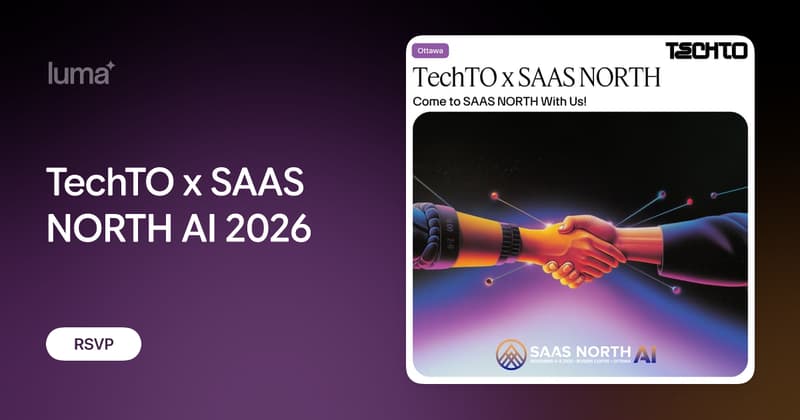
TechTO x SAAS NORTH AI is back!
Join us at Canada’s Largest Gathering Of AI-SaaS Founders.
When: Ottawa, Nov 4–5.
All-access pass through us, ~40% off
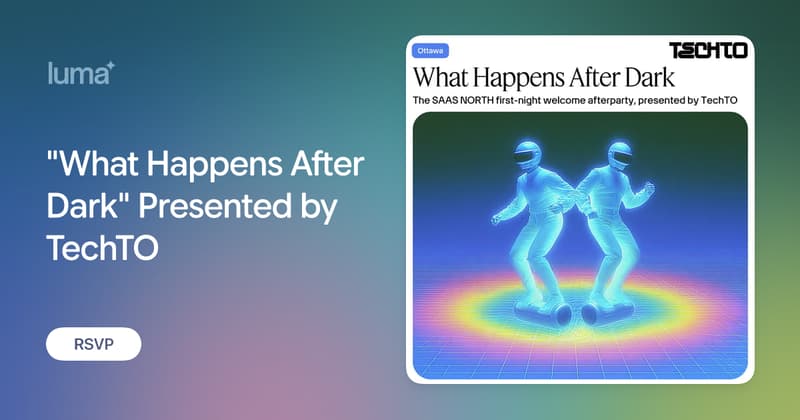
What Happens After Dark, our welcome-day afterparty (free for members)
Opportunities to Watch
Three ways to get more out of the next Together, depending on where you are:
Early-stage and want feedback? Pitch in front of our VCs from 5 to 6 pm on August 10, right before the event kicks off. Apply to pitch (choose “Founder Pitch Session” ticket type).
Want customer feedback before you build more? Join our Founder Feedback Booth during the networking hour from 6–7 PM. TechTO brings together ~400+ founders, operators and builders every month, giving you the chance to talk directly with people who may experience the problem you’re solving. It’s designed for customer discovery, not pitching, so you can leave with honest insights and clearer direction. Apply here.
Building a food or beverage brand, or know someone who is? Email [email protected] as we we continue expanding opportunities for local F&B providers to showcase their products at our events.
Ask any founder question. Get real answers.
We shipped AskTechTO. Type a question and it pulls answers straight from the 1,500+ talks founders have given on our stage, with the exact clip to watch.
No theory, no filler. Every answer comes from a founder who's actually done it.
If you’ve been showing up to TechTO for a while, membership is the next layer - $4.80 a week. TechTO members receive complimentary access to members only slack, monthly TechTO-hosted Together events, quarterly industry vertical events and socials.
Annual: $249/year | Founding: $1,199 One-time payment, lifetime access

Want to showcase your company, events, and opportunities to thousands of tech leaders, professionals, and investors across the country?
Contact us about potential partnership and advertising opportunities
Speak naturally. Send without fixing.

Wispr Flow turns your voice into clean, professional text you can send the moment you stop talking. Not rough transcription you have to clean up. Actual polished text — ready for email, Slack, or any app.
Speak the way you think. Go on tangents. Change your mind mid-sentence. Flow strips the filler, fixes the grammar, and gives you text that reads like you spent five minutes writing it.
89% of messages sent with zero edits. Millions of professionals use Flow daily, including teams at OpenAI, Vercel, and Clay. Works on Mac, Windows, and iPhone.
