

Sponsored by

You are receiving the Community Edition of today’s newsletter - upgrade to a Member to receive additional perks and experiences
Ninety-one Canadian rounds got announced in BetaKit so far this year. We pulled every one of them. And the thing founders say most often about raising here turns out to be mostly noise.
The complaint goes like this: it's harder to raise in Canada, and when you do, the cheque is smaller. The 2026 data doesn't back the second half up.
BetaKit's announced 2026 seed median is C$5.4M. Carta's U.S. seed median, converted to Canadian dollars, is C$5.8M. That's a 7% gap, inside the margin of noise. The seed rounds that actually get done here are the same size as the American ones.
And it's not just the midpoint. The middle half of Canadian seed rounds ran from C$4.2M to C$10.1M, with the biggest at C$21M. The U.S. average sits higher, but that's a handful of mega-rounds, think repeat founders, hot categories (e.g. foundational models, physical AI), dragging the mean up, not the typical founder pocketing more.
While the raise is roughly the same one thing isn’t the time to raise and one might be different the valuation.
According to Startup Genome research, Canadian founders take more than five months longer to close a seed, and 12–15% fewer reach a funded round at all.
Part of that is geography. The domestic seed investor base is thin, so filling a real pipeline usually means pitching in New York, San Francisco, or Boston - even when your lead ends up being Canadian. That travel and calendar drag is most of the extra five months not weaker companies, just a smaller pond you have to leave to fish properly.
One thing we could not conclude from our research is the valuation at Seed. It is possible that the amount raised is the same but the dilution is higher in Canada. Investors have similar expectations of ownership but it doesn’t guarantee they get it.
How we ran the numbers
We pulled all 91 Canadian-linked financings announced on BetaKit between January 1 and July 20, collapsed them to one round each, stripped out the debt and venture-facility dollars that inflate totals, kept everything in CAD, and isolated the 19 seed rounds that disclosed a real amount. Then we lined that median up against Carta's July benchmark of 1,000-plus U.S. software rounds. For what BetaKit can't see, time to close, success rate; we leaned on the Startup Genome study.
Why it feels worse than it is
Four reasons the "you can't raise here" story sticks:
The biggest rounds get all the airtime, and almost every early-stage giant is a U.S. repeat founder in a hot category.
It's a bigger time sink here. You usually have to go beyond your own city to make enough contacts, even when you close locally.
Fewer deals get done, so you're less likely to personally know someone who just raised.
Canadian founders are quieter about it. Most of what you read is American, and from the outside it looks easy over there.
What to do with it
Ignore the noise: you can raise a normal-sized seed in this country. Then treat it like the sales process it is. Plan for the whole funnel, 75 to 150 qualified investor contacts to land 30-45 first meetings, a couple of term sheets, one close. That's the cross-market benchmark for any seed raise, not a Canadian tax. Qualify your list, run it wider than your postal code, and budget the months it actually takes.
And watch the price, not just the size. A fast yes at a bad valuation can cost you more than a slow one at a fair number. Know your floor before you walk in. Don't let a matching cheque size talk you out of asking what you're giving up for it.
You'll need more shots on goal than the Twitter version suggests. Take them.
This is why most of you said VCs are asking too much
Last poll: has Canadian venture capital stopped taking venture risk? 63% of you picked "investors now require too much proof."
The data backs the instinct, with a twist. The money didn't shrink. The cheque is the same size as an American seed. What changed is the bar to clear it: more proof, more meetings, five months longer to close. The capital didn't leave. The hurdle got taller.
This week: want us to go deep on how to actually raise?
We gave you the funnel numbers above - 75 to 150 contacts, 30–45 meetings, one close. But that's the shape, not the how.
So tell us. If enough of you want it, the next issue (or an event) breaks down the full playbook: building the investor list, running the process like sales, reading a term sheet, and protecting your valuation.
Would you like us to go in-depth on how to raise a round?
Before Together Toronto on August 10, we're running an advance session from 5:00 to 6:00pm - bring your pitch to a room of VCs for unfiltered feedback before the main event starts at 6. Limited spots only, approval required.


Speaker spotlight: Matt Himel, founder & CEO of Harvest
Matt Himel spent eight years helping build Drop before he went and did the thing most people only talk about - started his own company. Now he's founder and CEO of Harvest, an AI tool that automates invoice follow-up for Canadian businesses (it plugs into QuickBooks, Xero, and your email, chases overdue accounts, and keeps the relationship intact while it does).
He's a former lawyer, which shows up in how he thinks. In his words:
"Ignore all the noise, go deep on a problem, solve it for the people who need it most, then expand."
And on the part nobody warns you about:
"The wins can pass without enough celebration, while the losses can feel completely soul-crushing. That's why it's important to get off the island - to talk to other founders, advisors, investors, people who understand the journey."
That's the whole point of August 10. Get off the island. Come hear how Matt found conviction to "live and die by his own decisions".
→ Grab your spot for Together Toronto, Aug 10 (Free for TechTO Members)
TechTO x SAAS NORTH AI is back. Who's in?
Join us at Canada’s Largest Gathering Of AI-SaaS Founders.
When: Ottawa, Nov 4–5.
All-access pass through us, ~40% off
We travel up together - the OG TechTO bus or a private NectAir flight, you help us pick
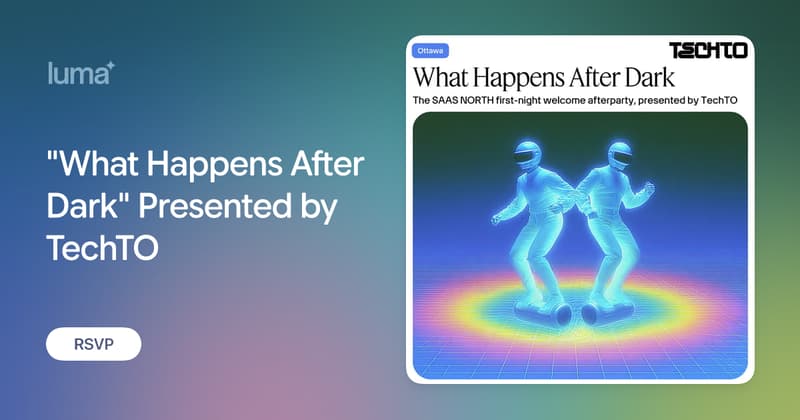
What Happens After Dark, our welcome-day afterparty (free for members)

Ask any founder question. Get real answers.
We shipped AskTechTO. Type a question and it pulls answers straight from the 1,500+ talks founders have given on our stage, with the exact clip to watch.
No theory, no filler. Every answer comes from a founder who's actually done it.
If you’ve been showing up to TechTO for a while, membership is the next layer - $4.80 a week. TechTO members receive complimentary access to members only slack, monthly TechTO-hosted Together events, quarterly industry vertical events and socials.
Annual: $249/year | Founding: $1,199 One-time payment, lifetime access

Expense receipts shouldn't require a search party

Adam spent 20 minutes looking for a $36 receipt. His finance team sent three Slack messages. Someone made a sticky note.
Ramp would have matched it automatically the moment he swiped. Auto-coded, in-policy, synced. Nobody had to ask Adam for anything.
This is what finance looks like when it runs itself.
Your team can be Adam. Or they can not be Adam.
Want to showcase your company, events, and opportunities to thousands of tech leaders, professionals, and investors across the country?
Contact us about potential partnership and advertising opportunities
